Presumptive Parity: A New Principle for America's Patchwork of Exempt Capital Markets
The Securities and Exchange Commission (SEC) proposed Regulation Crypto Assets on August 18. Comments are due October 20.
Nothing is final. It is a proposing release, open for comment, and the rules may change before adoption.
Law360 published my argument about it on August 25, under the headline, "A Guiding Principle For The SEC On Exempt Capital Markets." What follows is the same doctrine with the parts I could not fit there.
The doctrine, in four sentences:
Presumptive Parity means that when the SEC creates or materially changes an exempt capital-raising pathway, it should compare that pathway with similarly situated existing pathways. Comparable opportunities and burdens should be the starting assumption unless meaningful differences justify different treatment. The burden of identifying a meaningful difference falls on whoever defends the disparity, and novelty alone is not such a difference. Where no justification exists, the Commission should move toward parity to the exte...more
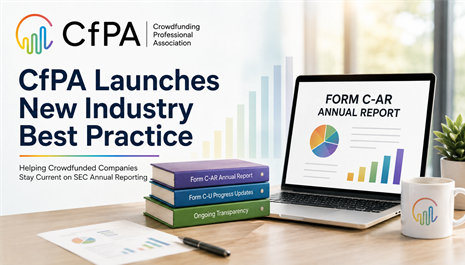
CfPA Introduces Industry Best Practice for Reg CF Annual Reporting
 Crowdfunding Professional Association (CfPA)
The Crowdfunding Professional Association (CfPA) has introduced a new industry Best Practice designed to help companies raising capital under Regulation Crowdfunding better understand their ongoing SEC reporting responsibilities.
Companies that sell securities through Regulation Crowdfunding are generally required to file an annual report on Form C-AR within 120 days of the end of their fiscal year and post the report on their website. Annual reporting continues until the company qualifies to terminate its reporting obligation under SEC rules and files Form C-TR.
While compliance with these requirements remains the responsibility of the company—not the funding portal or broker-dealer that facilitated the offering—CfPA believes the industry can help reduce inadvertent noncompliance by making these obligations clear before an offering begins.
Under the new Best Practice, CfPA encourages Reg CF intermediaries to consider incorporating an acknowledgment of ongoing reporting responsibilitie...more
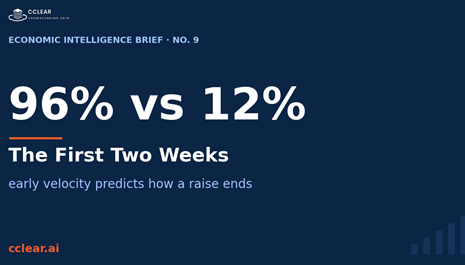
The first 14 days of your offering might be the most important ...
A startup's first 14 days predict how its entire raise ends. We can prove it.
We tested it out of sample across 6,300+ offerings. The fastest-starting quartile finished strong 96% of the time. The slowest quartile? 12%.
The signal holds up year after year (AUC 0.88 to 0.92). Momentum isn't a vibe. It's measurable, and it's predictive.
To be clear, this predicts the raise, not the investment return.
A question for the operators: if the first two weeks are this decisive, is a slow-starting campaign already finished, or can a raise still be saved once it stalls?
Comment "CCLEAR" and I'll send you the full brief.
...more
Silicon Valley's grip on startup capital is slipping.
In crowdfunding, the data already shows it. 64% of funded Reg CF capital now goes to companies outside California, New York, and Massachusetts, up from 47% in 2016. The top five states' share fell from 74% to 52%. California alone went from 44% to 26%.
And the per-resident leaders aren't who you'd guess: Wyoming, Nevada, Utah, Colorado. Take away the gatekeepers and the map of where innovation gets funded looks nothing like the venture map.
A real question: is capital actually decentralizing, or is crowdfunding just reaching the places venture was never going to fund anyway? Curious which way people see it.
Comment "CCLEAR" and I'll send you the full brief.
...more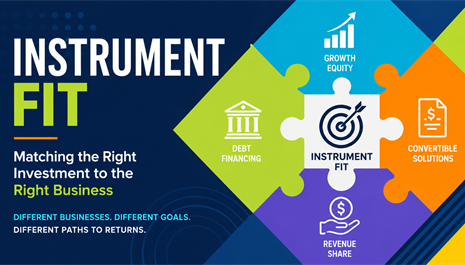
Instrument Fit: Matching the Security to the Business in Regulated Investment Crowdfunding
When Regulation Crowdfunding (Title III of the JOBS Act) launched in 2016, the industry's first challenge was simple: prove that ordinary investors could participate responsibly in private-company investing and that startups could successfully raise capital from their communities.
To do that, the market relied on familiar securities. Common stock, convertible notes, and later SAFEs had already been developed for venture-backed startups pursuing rapid growth and eventual exits.
That made sense.
Today, however, Regulated Investment Crowdfunding (the umbrella term CfPA has adopted as a Recommended Best Practice for the SEC- and FINRA-regulated exemptions created by the JOBS Act, of which Regulation Crowdfunding is one) serves a much broader market. Established operating businesses, consumer brands, technology startups, local enterprises, real estate ventures, and mission-driven organizations all raise capital under these exemptions. These businesses have very different capital needs and v...more
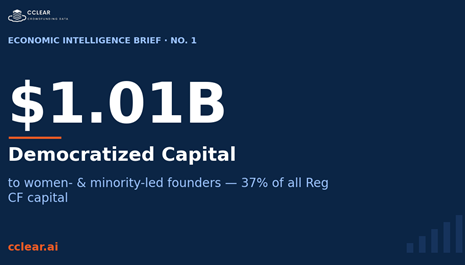
37% of all RegCF Capital has Gone to Women/Minority Founder Companies
More than $1 billion has gone to women- and minority-led companies through Regulation Crowdfunding. That's 37% of all the capital raised.
For comparison: all-women teams get about 2% of traditional venture capital.
When you let the crowd decide, the capital distributes very differently. Women- and minority-led founders' share has climbed from 24% in 2016 to nearly 39% today, across 52 states and territories.
This is what democratized access to capital actually looks like in the data.
A question for the room: is the crowd better at backing founders that institutions overlook, or is venture capital simply optimizing for something else? Curious where people land.
Comment "CCLEAR" and I'll send you the full brief.
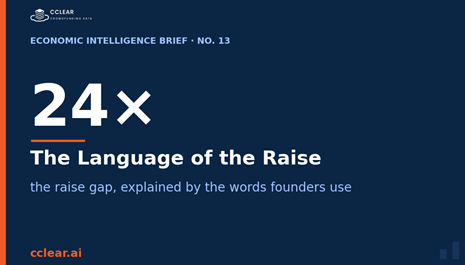
Words matter in your pitch - We know ... we analyzed 6,800 of them!
We read 6,800 funded RegCF pitches. The words that raise the most money aren't the ones you'd expect.
The gap between a top-quartile raise and a bottom-quartile one is 24x. So we ran the language through NLP to see what separates them.
It isn't hype. "Revolutionary" and "disrupt" don't move the needle. Sentiment, length, and buzzwords like "traction" show no advantage at all.
What the big raises actually talk about: FDA approvals, clinical pipelines, recurring revenue, clean energy, real assets. The language mirrors the business — substance beats spin.
Comment "CCLEAR" and I'll send you the full brief. #Startups #NLP #Fundraising #RegCF #DataScience
...more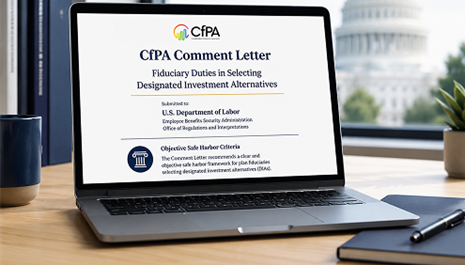
CfPA Urges Department of Labor to Provide a Meaningful Fiduciary Safe Harbor for Alternative Assets in Retirement Plans
WASHINGTON, D.C. – May 27, 2026
The Crowdfunding Professional Association (CfPA) announced that its public comment letter to the U.S. Department of Labor is now available on Regulations.gov, responding to the Department’s proposed rule, “Fiduciary Duties in Selecting Designated Investment Alternatives” (RIN 1210-AC38).
The proposed rule would clarify how ERISA’s duty of prudence applies when plan fiduciaries select designated investment alternatives for participant-directed retirement plans, including asset allocation funds that may include alternative assets.
CfPA commended the Department for advancing a process-based, asset-neutral framework that preserves fiduciary discretion while recognizing the evolving role of private-market investment opportunities. At the same time, CfPA urged the Department to make the proposed safe harbor more practical by adding objective criteria and documentation thresholds that fiduciaries can apply consistently.
“Expanding access to private markets shou...more