
When Regulation Crowdfunding (Title III of the JOBS Act) launched in 2016, the industry's first challenge was simple: prove that ordinary investors could participate responsibly in private-company investing and that startups could successfully raise capital from their communities.
To do that, the market relied on familiar securities. Common stock, convertible notes, and later SAFEs had already been developed for venture-backed startups pursuing rapid growth and eventual exits.
That made sense.
Today, however, Regulated Investment Crowdfunding (the umbrella term CfPA has adopted as a Recommended Best Practice for the SEC- and FINRA-regulated exemptions created by the JOBS Act, of which Regulation Crowdfunding is one) serves a much broader market. Established operating businesses, consumer brands, technology startups, local enterprises, real estate ventures, and mission-driven organizations all raise capital under these exemptions. These businesses have very different capital needs and very different paths to creating investor value.
Yet the industry still often begins with the assumption that every issuer should offer essentially the same type of security.
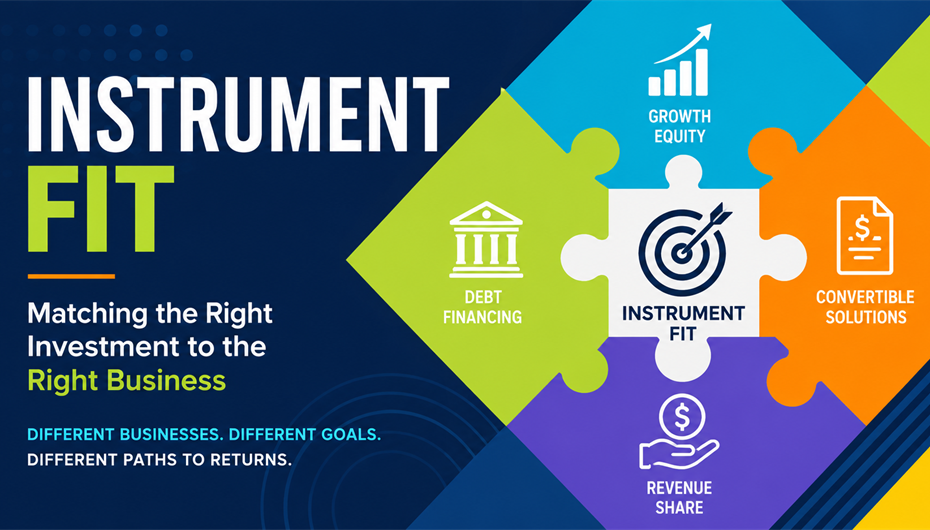
CfPA member Paul Lovejoy coined the phrase "instrument fit" in the context of crowdfunding and I believe it's an important addition to the vocabulary of Regulated Investment Crowdfunding. Much as "product-market fit" has become central to the startup ecosystem, instrument fit recognizes that not every company should use the same financing structure. Instead, the investment instrument should be tailored to the company's business model, growth strategy, and investor community.
In a sense, the idea is already embedded in the industry's name. When CfPA recommended "Regulated Investment Crowdfunding," part of the reasoning was that "investment" - rather than "equity" - signals that offerings are not limited to any single type of security. Instrument fit takes that premise seriously.
One Size Doesn't Fit All
A SAFE works well for a startup that expects another venture financing. Investors understand that their investment will convert when a future priced round establishes the company's value.
But what if that financing never happens?
What if the company instead grows steadily, becomes profitable, and never seeks institutional capital or an acquisition?
In that case, investors may own an instrument that depends on a future event that never occurs.
That doesn't make SAFEs bad. It simply means they fit some companies better than others.
The same principle applies to equity and debt. Equity may be ideal for companies that need years of reinvestment before generating returns. Traditional debt may work well for businesses with predictable cash flow but place unnecessary strain on earlier-stage companies that cannot yet support fixed payments.
The question is not whether one instrument is superior to another.
The question is whether the instrument fits the business.
The CARE Note
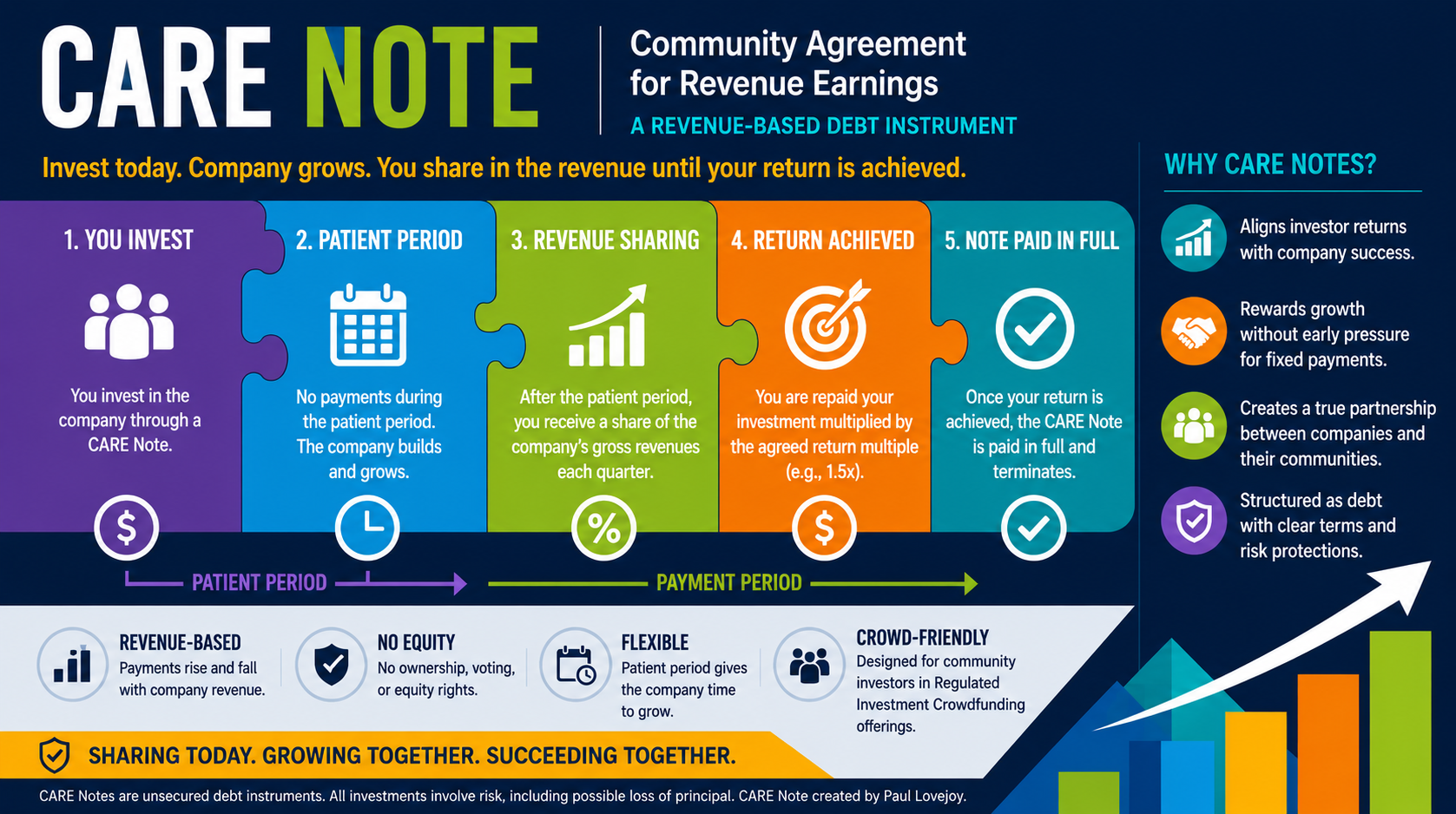
The Community Agreement for Revenue Earnings (CARE) Note developed by Paul Lovejoy with input by crowdfunding attorney and 2026 CfPA board Chair, Jenny Kassan, illustrates how a security can be designed around a company's economics rather than adapted from venture capital.
The CARE Note is a revenue-based debt instrument. After an initial patient period that allows the company time to grow, investors collectively receive an agreed percentage of the company's gross revenue, shared pro rata, until they have received a fixed multiple of their original investment. And the revenue share does not run indefinitely: the note carries an outside maturity date, at which any unpaid balance comes due, so investors are not left waiting on revenue that never materializes.
Unlike a SAFE, the CARE Note does not depend on a future financing. Unlike conventional debt, payments rise and fall with company revenue rather than following a fixed amortization schedule. Unlike equity, it does not grant ownership or voting rights.
It remains debt, with the risks that entails. It is unsecured, subordinate to certain senior obligations, and investors may lose money if the business underperforms.
The CARE Note will not be appropriate for every company.
That's precisely the point.
Matching the Security to the Company
A pre-revenue technology startup - a company still years away from its first sale, building toward future venture rounds - is perhaps the clearest illustration of instrument fit at work. With no revenue to share, a revenue-based instrument simply cannot fit; such a company is best served by equity or an equity-linked instrument, because investors expect value to be realized through future financings or an acquisition.
A profitable consumer business, by contrast, might be better suited to revenue-based financing. A mature business with predictable cash flow may appropriately issue debt.
None of these structures is inherently better than the others. They simply solve different financing problems.
When structuring a Regulated Investment Crowdfunding offering, issuers should work through a handful of practical questions: whether the company is likely to raise institutional capital later, whether an acquisition is a realistic objective, when the business will begin generating revenue, whether it can support fixed repayments, and how investors should reasonably expect to earn a return. Those answers - not familiarity - should drive the choice of security.
Innovation Is the Next Chapter
The first decade of Regulation Crowdfunding proved that the exemption works.
The next decade of Regulated Investment Crowdfunding will be defined by innovation.
We're beginning to see investment instruments designed specifically for this market rather than borrowed from venture capital or traditional finance. The CARE Note is one example, and it is unlikely to be the last.
That experimentation should be welcomed. Regulated Investment Crowdfunding was itself an innovation in securities law. It should not be surprising that innovation is now occurring within the securities offered under it.
If Paul Lovejoy is right that "instrument fit" belongs in the industry's vocabulary, then the future of Regulated Investment Crowdfunding will be shaped not only by who can raise capital, but by how thoughtfully that capital is structured.
You can download the CARE Note here.
This article is for educational purposes only and is not investment advice, legal advice, or an offer or solicitation to buy or sell any security. The author is a co-founder of The BioTech Funding Portal LLC, a FINRA-registered Regulation Crowdfunding funding portal.
Register for FREE to comment or continue reading this article. Already registered? Login here.
7
Why This Matters: The conversation around Regulation Crowdfunding has historically focused on who can invest and how companies raise capital. This article shifts the discussion to an equally important question: Are we using the right investment instrument for the right business? By introducing Paul Lovejoy's concept of "instrument fit," it encourages founders, funding portals, attorneys, and investors to move beyond one-size-fits-all thinking and thoughtfully match a company's financing structure to its business model, revenue profile, and long-term strategy.
The article argues that this represents an important evolution for the industry. Just as "product-market fit" became a defining concept in entrepreneurship, "instrument fit" has the potential to become a foundational principle of Regulated Investment Crowdfunding. Through the example of the CARE Note, it demonstrates how new investment structures can better align the interests of companies and investors than traditional venture-oriented securities in many situations.
As the crowdfunding industry enters its second decade, this perspective challenges market participants to embrace innovation not only in expanding access to capital, but also in designing smarter, more appropriate investment instruments. If widely adopted, "instrument fit" could become one of the concepts that defines the next generation of regulated crowdfunding.