- Home
- Q&A
-
Is my company a fit for investment crowdfunding? Is my company a fit for investment crowdfunding?
Good question. No one can answer this question with certainty -- but there are some attributes that could help make your company a good fit.
First, if your company has a compelling story, a clear growth plan, and a product or mission that everyday people can understand or get excited about, then yes... more
- Consultants
-
Is the TRUMP Jobs Act the same as the 2017 Tax Cuts and Jobs Act or its extension? Is the TRUMP Jobs Act the same as the 2017 Tax Cuts and Jobs Act or its extension?
No. The TRUMP Jobs Act is a completely different proposal - and a far better one. It’s focused on powering small business growth and local job creation, not reinforcing the failed trickle-down policies of the past.
Here’s how they differ:
The TRUMP Jobs Act:
Backed by the Coalition for Crowdfunding A... more- Unclassified
-
How could SEC Commissioner Peirce's sketch of an idea for a potential exemption from registration to allow firms to use DLT to issue, trade, and settle securities potentially impact regulated investment crowdfunding?
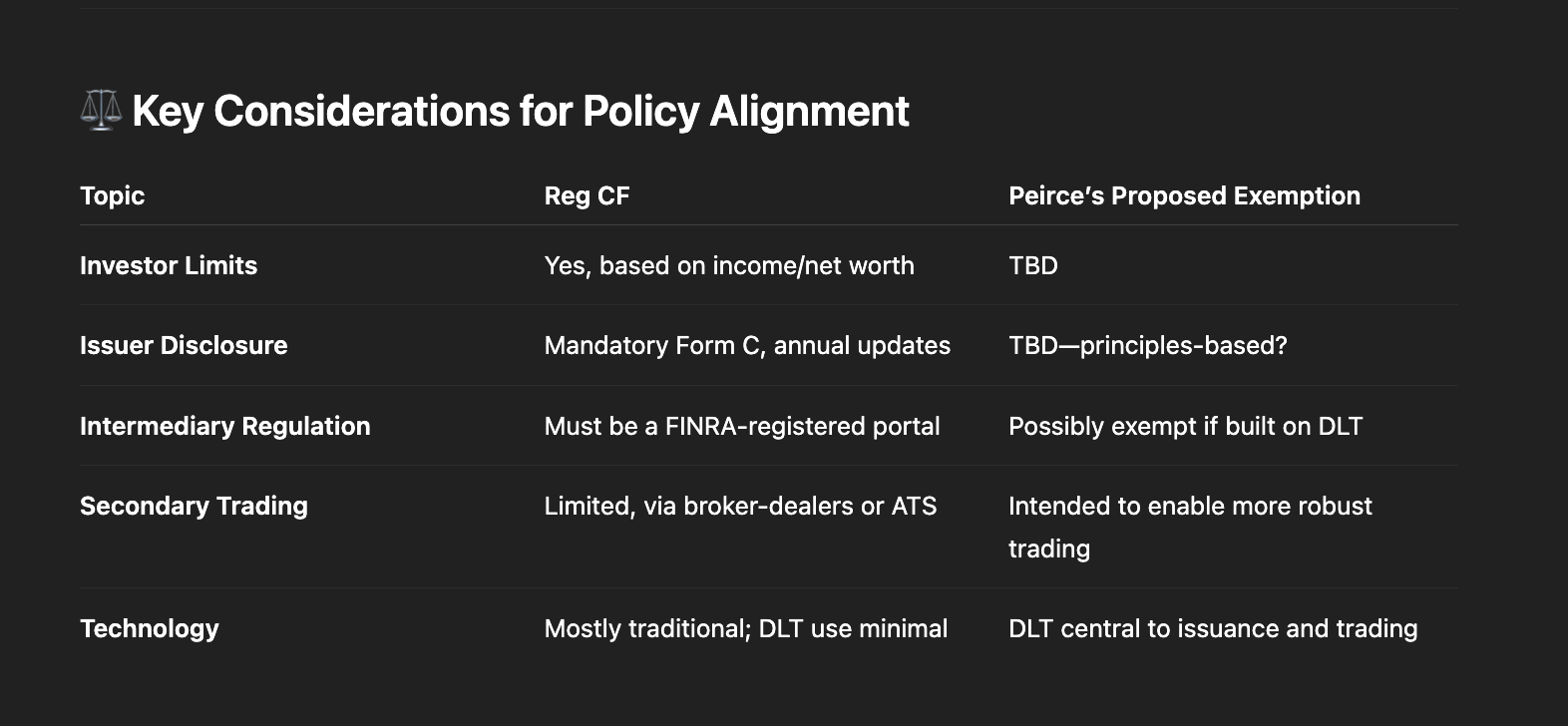
SEC Commissioner Hester Peirce’s sketch of a potential exemption from registration to allow firms to use distributed ledger technology (DLT) to issue, trade, and settle securities could have significant implications—both positive and disruptive—for regulated investment crowdfunding (Reg CF). Here's ... more
SEC Commissioner Hester Peirce’s sketch of a potential exemption from registration to allow firms to use distributed ledger technology (DLT) to issue, trade, and settle securities could have significant implications—both positive and disruptive—for regulated investment crowdfunding (Reg CF). Here's a breakdown of the potential impacts:
🔍 How the DLT Exemption Could Affect Reg CF1. Creates a Competing Capital Formation Pathway
If the exemption enables issuers to raise capital and trade tokenized securities more flexibly than under Reg CF, it could:- Draw issuers away from Reg CF, especially those seeking lower compliance burdens or faster execution
- Undermine the utility of funding portals that have invested in compliance infrastructure under Reg CF/Reg A
2. Erodes Investor Protections If Not Carefully Calibrated
Reg CF includes robust investor caps, disclosures, and portal oversight:
- If DLT-based exempt offerings don't include equivalent protections, retail investors may be exposed to higher risks without adequate guardrails.
- This could weaken confidence in retail-facing investment markets broadly
3. Undermines Level Playing Field for Intermediaries
Funding portals must:
- Register with the SEC and FINRA
- Implement anti-fraud procedures
- Adhere to strict communication guidelinesIf a DLT-based venue is exempt from similar obligations, it may function like a funding portal or ATS without having to comply with equivalent rules—creating an unfair regulatory asymmetry
4. Tokenization Could Be a Tool—Not a Threat—If Integrated
If the exemption framework evolves to support tokenized Reg CF securities, it could:
- Enable faster settlement and secondary liquidity for crowdfunding investors
- Enhance investor engagement through programmable assets, wallet integration, and smart contracts
- Lower custody costs and improve capital stack transparency
🧭 Strategic Implications for the Regulated Crowdfunding Industry
If Not Integrated:
- Funding portals may lose deal flow to lightly regulated DLT venues
- Investor confusion could rise as new platforms emerge without clear SEC/FINRA alignment
- Reg CF infrastructure could be marginalized, despite years of ecosystem-building
If Proactively Integrated:
- Portals that embrace DLT for post-issuance management or settlement could lead innovation
- Reg CF rules could evolve to explicitly allow for tokenized securities, with safe harbor language
- SEC could require exempt DLT platforms that target retail to meet Reg CF-like protections
✅ Recommendations for Industry Stakeholders and Policymakers1. Advocate for Harmonization:
Ensure any DLT exemption includes equivalent investor protection standards as Reg CF.
2. Push for Tokenized Reg CF Pathways:
Encourage the SEC to issue guidance or no-action relief for DLT use within Reg CF, especially around custodial tokens, secondary transfers, and smart contract-based compliance.
3. Monitor Market Fragmentation Risk:
Prevent two-tier markets—one regulated (Reg CF), one not—by ensuring oversight parity.
4. Participate in Public Comment:
As the SEC considers exemptive relief, funding portals, investor advocates, and Reg CF issuers should engage directly with the Crypto Task Force’s process.
🔗 In SummaryPeirce’s DLT exemption sketch is forward-looking and pro-innovation—but it may unintentionally disrupt the fragile progress of regulated crowdfunding unless protections and standards are aligned. The future could be synergistic, but only with clear boundaries and deliberate coordination.
Note: Commissioner Peirce's thoughts are outlined here: https://www.sec.gov/newsroom/speeches-statements/peirce-iismgd-050825
less -
Can you comment on Paul S. Atkins Sworn In as SEC Chairman based on the SEC Press Release and from the perspective of the crowdfunding industry? https://www.sec.gov/newsroom/press-releases/2025-68
From the perspective of the regulated investment crowdfunding (Reg CF and Reg A) industry, the appointment of Paul S. Atkins as SEC Chairman raises both opportunities and questions.
🔎 Perspective from the Crowdfunding Industry:
1. Pro-Market, Pro-Business Philosophy Could Mean Support for Capital F... more
From the perspective of the regulated investment crowdfunding (Reg CF and Reg A) industry, the appointment of Paul S. Atkins as SEC Chairman raises both opportunities and questions.
🔎 Perspective from the Crowdfunding Industry:
1. Pro-Market, Pro-Business Philosophy Could Mean Support for Capital Formation. Chairman Atkins has long championed capital formation and reduced regulatory burden, particularly through cost-benefit analysis. This mindset aligns well with the goals of the crowdfunding sector, which seeks to democratize capital access for startups and small businesses. His background suggests he may be open to expanding access to capital for both issuers and investors through mechanisms like Reg CF and Reg A+.
2. Track Record of Favoring Innovation—Positive for Fintech and Digital Asset Integration
Atkins’ role in developing best practices for the digital asset sector suggests he’s not afraid to engage with new technologies.
This could bode well for:
- Tokenized securities
- Blockchain-based cap tables
- Smart contract-based compliance —all areas that the crowdfunding industry is beginning to explore.3. Potential for Regulatory Rollbacks or Modernization
Atkins has previously pushed for greater consistency and simplification in regulation. That could open the door to:
- Raising Reg CF investment and offering limits
- Reducing duplicative state filing burdens
- Streamlining ongoing disclosure requirements
- Allowing more flexible use of SPVs and follow-on offerings4. Investor Protection vs. Market Access
However, Atkins' emphasis on cost-benefit analysis and industry flexibility may worry some investor advocates who want stronger safeguards in crowdfunding. There is a delicate balance here. The crowdfunding industry—especially responsible funding portals and associations like CfPA—will need to proactively demonstrate that investor protection and market growth can co-exist.
5. A Chance for Dialogue
Given his extensive experience across SEC leadership roles and international regulatory forums, Atkins is likely to be receptive to policy engagement. This is a valuable opening for the crowdfunding industry to:
- Push for rule modernization
- Advocate for new exemptions or refinements
- Collaborate on digital compliance infrastructure
📣 Final Thought:The appointment of Paul S. Atkins could signal a more business-friendly, innovation-minded SEC. The crowdfunding industry should engage early and often, presenting data, success stories, and constructive proposals to shape a regulatory environment that protects investors without stifling innovation. If navigated well, this could be a turning point for scaling regulated crowdfunding in the U.S. capital markets.
#regulatedinvestmentcrowdfunding
less2 -
If a company files more than one Fprm C- do they need to file a c-at for each raise or just one for the entire year?
A Form C-AR relates to a company, not to a particular raise. You file one C-AR regardless of how many offerings you did.
3 -
Who Supports the Beneficiaries of the TRUMP Jobs Act? Who Supports the Beneficiaries of the TRUMP Jobs Act?
The TRUMP Jobs Act benefits working-class investors and small businesses. 80% of Trump voters and 77% of swing voters believe American tax policy should prioritize small businesses and working-class investors. In contrast, only 4% of Trump voters and 2% of swing voters think tax policy should favor ... more
- Unclassified
-
Is the TRUMP Jobs Act offering a deduction or tax credit to investors? Is the TRUMP Jobs Act offering a deduction or tax credit to investors?
The TRUMP Jobs Act is proposing a tax credit.
A tax deduction reduces your taxable income, lowering the amount of income that is subject to tax. The actual tax savings depend on your tax bracket. For example, if you're in the 24% tax bracket, a $1,000 deduction saves you $240 in taxes.
A tax c... more
- Unclassified
-
What kind of organizations should attend the Crowdfunding Summit? What kind of organizations should attend the Crowdfunding Summit?
Everyone is welcome!
The CfPA Summit will bring together key stakeholders in the Regulated Investment Crowdfunding industry, including funding platforms, investors, legal and compliance experts, fintech service providers, and policymakers and regulators. Issuers are welcome to attend to learn best p... more
- Media, Events & Publications
- Regulations & Compliance
- Unclassified
-
What are the rules governing use of the CfPA Logo? What are the rules governing use of the CfPA Logo?
Thank you for your question, anonymous.
The CfPA logo is available for use (website, email footers, etc.) under license by current members of CfPA in good standing (pay your dues!)
It is also available for use by partner organizations for specific events or activities (e.g. co-marketing of a... more
- Unclassified