
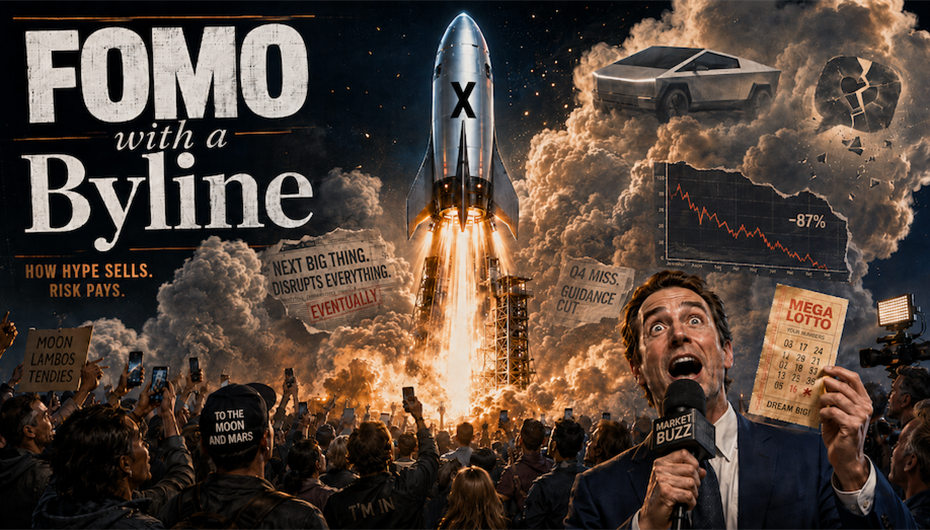
The New York Times recently published a piece titled “Want to Invest in SpaceX? Here’s What to Know Ahead of Its I.P.O.” In a section asking how much investors could make from the IPO, the article pointed to Tesla’s 2010 IPO and noted that a $1,000 investment in Tesla back then would be worth roughly $400,000 today.
That is not neutral context. That is jackpot framing.
Maybe the sentence is technically accurate. Maybe it is even relevant in the narrowest possible sense: Elon Musk led Tesla, Tesla went public, Tesla’s stock soared, and now another Musk company may go public. But journalism is not supposed to be a machine for laundering emotionally loaded anecdotes into investor excitement.
The message to readers is obvious: you missed Tesla, do not miss SpaceX.
That is FOMO with punctuation.
The deeper problem is the logical sleight of hand. Tesla’s past stock performance does not tell investors whether SpaceX is attractively priced. It does not tell them whether the IPO valuation already captures the company’s best future scenarios. It does not tell them whether public investors are buying into an early opportunity or becoming exit liquidity for private investors who already captured the exponential gains.
And it certainly does not prove that “Elon did it once, so he can do it again.”
If the article wants to frame SpaceX as a bet on Elon Musk, then it has an obligation to cover the entire Musk record - not just the one example that makes retail investors salivate.
That means Tesla’s upside belongs in the story only alongside Musk’s downside.
It means mentioning the Cybertruck, a product Musk hyped for years as a category-defining vehicle, only for sales to badly disappoint expectations. It means mentioning the recalls, the quality concerns, and the gap between the futuristic promise and the commercial reality.
It means mentioning Twitter, now X, where Musk took a globally important communications platform private in a $44 billion deal, loaded it with debt, alienated advertisers, gutted institutional trust, and saw outside marks on the company collapse. If Tesla is evidence for the “Musk magic” thesis, then Twitter is evidence for the “Musk can destroy enormous value” thesis.
And it means mentioning the corporate entanglement among Musk’s companies. SpaceX is not simply a clean, standalone rocket company arriving on the public markets. It is increasingly part of a sprawling Musk ecosystem that includes satellites, rockets, artificial intelligence, social media, compute infrastructure, founder control, and related-party questions. When one Musk entity absorbs or supports another Musk entity, investors deserve to understand exactly whose risks they are being asked to underwrite.
That is not a side issue. That is the issue.
Because the public pitch for SpaceX will not be only about rockets. It will be about Musk. It will be about the myth of the impossible founder. It will be about Tesla. It will be about Mars, AI, satellites, national security, and the idea that ordinary investors are being handed a rare chance to ride along with history.
Fine. Then cover the myth honestly.
A serious investor article would not merely ask, “What if SpaceX is the next Tesla?” It would also ask:
What if SpaceX is being priced as if it is already the next Tesla?
What if the easy money was made while the company was private?
What if public investors are not early believers, but late-arriving liquidity?
What if Musk’s attention is divided across too many companies?
What if SpaceX capital is being used to absorb risks created elsewhere in the Musk empire?
What if related-party transactions, founder control, and retail investor enthusiasm combine to weaken ordinary market discipline?
What if the same personality cult that helped Tesla become a stock-market phenomenon also blinds investors to valuation, governance, and execution risk?
Those are not anti-Musk questions. They are basic investor-protection questions.
The Times piece even quotes an IPO expert saying, “The time for being an early investor in SpaceX has sort of passed.” That should have been the thesis. Instead, the Tesla comparison becomes the emotional payload.
This is how hype enters respectable financial journalism. Not through an explicit recommendation. Not through a crude “buy this stock” command. But through narrative gravity. Through the careful placement of a spectacular historical return next to the question every reader wants answered: “How much could I make?”
That is not analysis. That is temptation.
If a reporter tells readers that $1,000 in Tesla became roughly $400,000, the reporter should also tell them that Musk’s record includes major destruction of value, overpromised products, missed timelines, reputational blowups, governance controversies, and business decisions that can force investors in one Musk venture to absorb risks created by another.
Otherwise the article is not educating readers about the bet. It is helping sell the dream.
SpaceX may be a remarkable company. It may become one of the most important public companies in the world. It may transform launch economics, satellite communications, national security infrastructure, and perhaps even the future of computing. None of that is impossible.
But none of it answers the investor’s actual question.
The question is not whether SpaceX is impressive. The question is whether the stock is a good investment at the price public investors are being asked to pay.
Those are different questions. Financial journalism should know the difference.
A great company is not automatically a great stock. A famous founder is not automatically a fiduciary blessing. A historic IPO is not automatically a historic opportunity for the people buying on day one.
The job of financial journalism is to slow investors down before they confuse a story with an investment case.
When reporters invoke Tesla’s once-in-a-generation return without equally foregrounding Musk’s failures, they are not giving readers the full picture. They are selecting the most intoxicating part of the record and letting it stand in for the whole.
That is not journalistic balance.
That is FOMO with a byline.
Register for FREE to comment or continue reading this article. Already registered? Login here.
5
Wow! This is a profoundly good analysis, Brian! Thank you so much!
I keep reflecting on this. Five years ago, I invested in Rivian (Nasdaq: RIVN) because I wanted one of the trucks and couldn't have been much more excited about the IPO.
I bought in around the $125 offering price (after the price peaked at $175 or so). I kept buying as the stock fell. A good deal at $125 is a better deal at $90! My average basis is about $75. The stock trades around $15 per share, so I only need it to quintuple to get my money back. That story is a bummer for me--and a lot of others who invested in the IPO.
Here's the thing about SpaceX: With a $1.75 trillion valuation, it is priced about 100 times above Rivian's inflated valuation. If SpaceX tanks, it will take the market with it--not just its investors.
Thank you Devin.
Ouch re: Rivian. A painful lesson that loving the company, loving the product, and even being directionally right about the long-term category does not mean the IPO price is rational.
You can be right about the story and still be wrong about the stock if the entry valuation already assumes perfection.
I read a sober analysis about SpaceX in the Damsker Report today.
Here's her article:
Should You Invest In SpaceX? I Analyzed Everything - And Here's The Verdict.
https://thedamskerreport.substack.com/p/should-you-invest-in-spacex-i-analyzed
Excellent quote by Charlie Munger at the end!
That post you shared is outstanding!