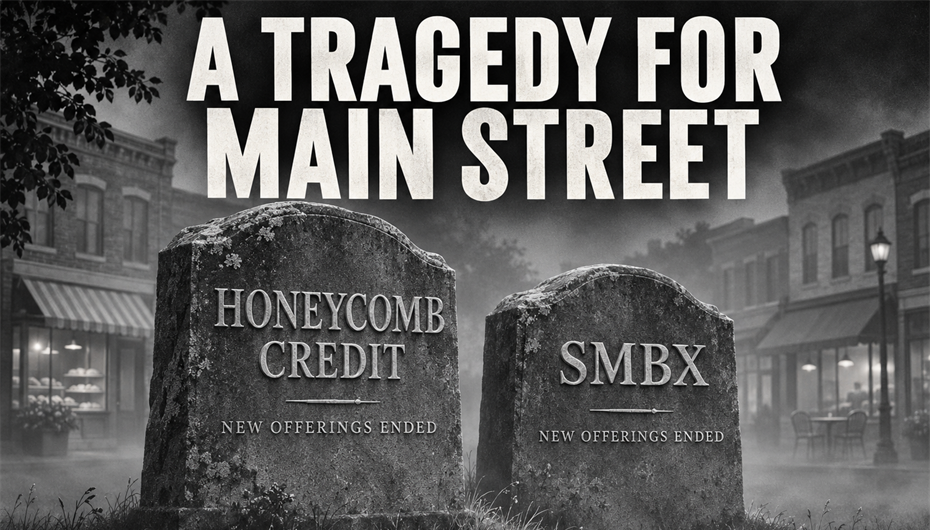
The loss of two vital lending platforms exposes a profound gap in small-business finance—and demands action from investors, founders and policymakers.
1. A tragedy for Main Street
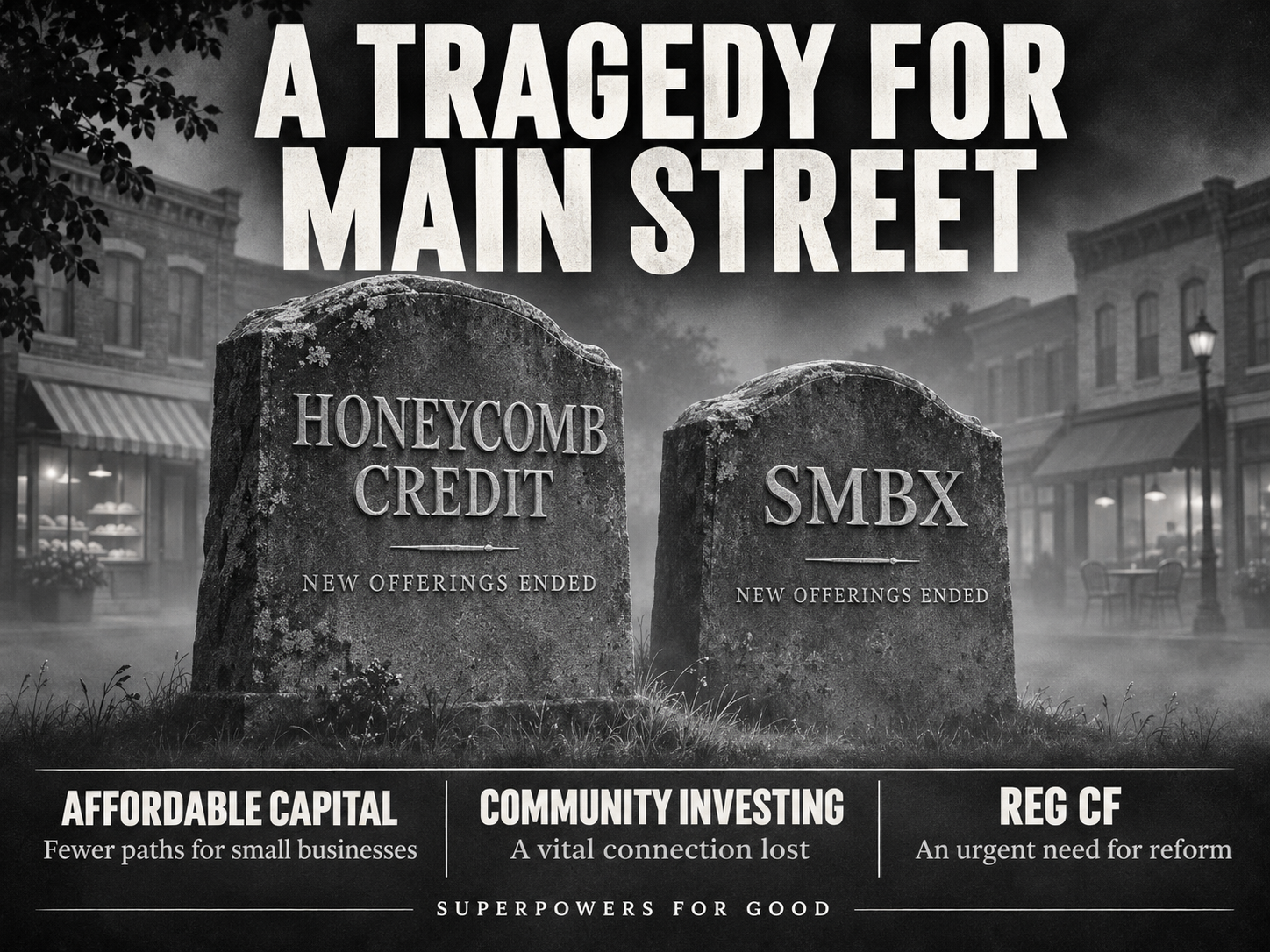
Honeycomb Credit is winding down its investment crowdfunding platform. Its announcement on November 13, followed by a December 3, 2026, shutdown of its Wallet and investor dashboard, marks a tragedy for entrepreneurs, investors and communities that deserved a better outcome.
The loss of SMBX as a source of new community loans, followed so quickly by Honeycomb, is deeply discouraging. Two platforms built to connect ordinary investors with ordinary businesses have ceased offering the financing that made them important. Their disappearance exposes a profound failure in Regulation Crowdfunding’s ability to serve Main Street.
This hurts personally.
I met Honeycomb cofounder George Cook nearly a decade ago, when he was launching the business. Over the years, I became his biggest fan. I admired his determination to make capital available to entrepreneurs whose businesses mattered enormously to their communities, even when they offered little attraction to conventional investors.
I was also a huge fan of Raise Green, the portal that helped everyday people invest in climate solutions. When Honeycomb acquired its assets, I was thrilled that its important work would continue. Seeing my friend and SuperCrowd member Jackie Logan bring her climate expertise to Honeycomb made that transition especially encouraging.
Now I grieve for what we are losing. And I recognize that whatever pain I feel, George, Jackie and their colleagues must be experiencing something infinitely deeper. They invested years of effort, professional identity and hope in this work. They deserve our compassion.
Consider Carina’s Bakery in Beaverton, Oregon.
When I interviewed founder Carina Comer for Superpowers for Good, I learned about a legally blind entrepreneur building a bakery around employment opportunities for people with disabilities. Her offering materials described nearly 50 employees over the bakery’s history, approximately 90% of whom had a disability. Some were getting their first opportunity to work.
I invested in her Honeycomb offering.
Her business brought together things I care deeply about: entrepreneurship, inclusion, dignity and the opportunity for everyday people to participate financially. Honeycomb enabled me to invest in that mission through a loan. The bakery ultimately reported raising $50,961.
Imagine the next entrepreneur like Carina looking for that opportunity.
The United States has more than 36 million small businesses. Many need $30,000, $75,000 or $150,000 to purchase equipment, expand a kitchen or hire employees. Venture capital and angel investors generally pursue businesses with the potential for extraordinary growth. SBA financing serves an important purpose, but many entrepreneurs struggle to qualify or obtain a loan suited to their needs.
In my view, these businesses represent Reg CF’s biggest and most important potential market. Communities could supply patient capital to enterprises they understand and value. Losing specialized portals serving that market is a failure with consequences far beyond the companies closing their doors.
Debt also gave investors a comparatively understandable way to participate.
A wonderful company can be a terrible equity investment at an inflated valuation. Recognizing that problem requires judgments about future growth, dilution, margins and eventual exits. Even experienced investors struggle. New investors face an especially difficult assignment.
A loan presents a more concrete question: Does this business generate enough cash to repay its debts?
Investors can examine revenue, expenses, existing obligations and the proposed payment schedule. Spotting an obvious mismatch between cash available and debt payments is often easier than determining a fair startup valuation. Forecasts can fail, financial information can disappoint, and borrowers can default. Still, the analysis is more accessible.
These loans could offer meaningful returns while providing financing a business could afford. Honeycomb’s typical stated rates were generally below 15%; SMBX advertised rates up to 11.5%. Origination and servicing fees increased borrowers’ total costs, so the stated rate alone never told the whole story.
Even so, those terms offered an alternative to the sharks charging annualized costs of 30% or more. The FTC has warned that some merchant cash advances carry estimated APRs in the triple digits. Financing can help a business grow; punishing repayment terms can consume the cash it needs to survive.
Honeycomb’s economic challenge deserves serious examination. Its investor presentation on Wefunder reported $1.25 million in 2025 revenue and projected profitability in 2027. It acknowledged that launching offerings required substantial hands-on work. Each small raise carried underwriting, compliance, marketing and administrative demands. Honeycomb also earned recurring servicing fees, which help support the work that continues after a loan closes.
Honeycomb’s notice blamed declining crowdfunding participation and rising offering costs. Those pressures matter because the marketplace needs three groups to succeed together. Investors need a reasonable prospect of repayment and a return. Entrepreneurs need financing that leaves enough cash to operate. The portal needs revenue sufficient to underwrite offerings, satisfy compliance requirements and support repayments. Squeezing any one of those groups eventually damages the other two. The tragedy is that we have yet to make that balance sustainable at the scale Main Street needs.
By the first nine months of 2026, Honeycomb accounted for 148 of 598 initial Reg CF filings—nearly one-quarter. Its own filing volume had declined, even as its share increased. Losing a participant of that scale threatens access for hundreds of future borrowers.
The climate-finance loss deepens the tragedy. Climatize is the only remaining U.S. Reg CF portal specializing in climate debt. Its clean-energy focus leaves the broader small-business lending gap unfilled. Other portals can host some community loans, but replacing the capacity and expertise we have lost will take sustained work.
In my judgment, this is Reg CF’s biggest failure to date. The framework has failed to sustain the specialists serving an enormous, essential market.
In the coming days, I’ll examine what must change so a portal can profitably serve these businesses while protecting investors. We owe that effort to entrepreneurs like Carina and to everyone who worked to give them a fair chance.
This needs to work.
2. What Honeycomb investors should do now
I am among the investors affected. Here is what I recommend doing now, using Honeycomb’s published transition instructions. The deadline is Thursday, December 3, 2026, at 4 p.m. Eastern—1 p.m. Pacific.
Verify your bank account before that deadline. Sign in and confirm that Honeycomb has the correct account for deposits. If none is linked, add one through online banking or manual entry. Honeycomb says those methods add the account immediately; processing an uploaded voided check can take one to three days.
Deal with your Wallet balance. Honeycomb plans to attempt a transfer of Wallet cash to the bank account on file on December 3. You may withdraw it earlier. For an earlier withdrawal, select Honeycomb Wallet, then Transfer, verify your bank details, enter the amount and confirm. Transfers generally take two to five business days. The per-transfer limit is $30,000; multiple transfers are permitted.
That transfer covers cash in your Wallet. Principal still invested in outstanding loans follows each loan’s repayment schedule. Borrowers remain responsible for paying their investors, and actual repayments depend on businesses making their payments.
Download your records while account access exists. Under Portfolio, choose “View/download all investment and payment details.” Export each of the Investments, Payments and Upcoming Payments tabs using Export data, then Download now. Save the CSV files somewhere you can find them. Also retain your notes, offering documents, statements and relevant correspondence. Save the FAQ alongside your other investment records.
For each investment, keep a record of the issuer’s legal name, your original investment, payments received, outstanding principal and expected payment dates. Those details will help you reconcile future deposits and ask precise questions if something goes wrong.
Know how future communication will work. Honeycomb anticipates facilitating repayments for the life of each enrolled loan, with deposits going directly to investors’ bank accounts. Monthly statements will arrive by email. After December 3, the logged-in portfolio experience ends; requests for investment and payment history go through the form on its FAQ page.
A business may choose to handle repayments itself. Honeycomb says that business becomes responsible for sending payments and encourages it to communicate directly with investors. Keep any instructions you receive and reconcile them with your existing investment records.
Honeycomb says it will provide 2026 tax documents and anticipates continuing in later years. Keep your email and mailing information current, and check your inbox and spam folder.
Use the appropriate contact if you need help. With no bank account on file at closure, contact Wallet provider Dwolla at support@dwolla.com about Wallet funds. Honeycomb instructs investors to email a voided check to servicing@honeycombcredit.com for future ACH payments or subsequent bank-account changes. Other requests use the FAQ form.
Honeycomb says investors will receive notice of delinquent payments not cured within 30 days through the default process in their note purchase agreement. Individual updates outside that process will end. Review your agreement and keep those notices. For my own investments, I will be watching actual deposits and preserving statements carefully through this transition.
3. What founders with Honeycomb loans should do now
For founders who raised debt through Honeycomb, this transition adds administrative work at a moment when you already have a business to run. Your investors need you to help them understand what happens next.
Keep making scheduled payments. Honeycomb directs borrowers to continue using LoanPro. Your LoanPro credentials differ from your Honeycomb login. Test access now and use LoanPro’s password-reset option if necessary. Check your next due date and payment arrangements, and retain confirmation of every payment. Confirm automatic payments remain properly scheduled and funded.
Honeycomb expects to continue servicing loans enrolled in its program for their remaining lives. Confirm how your own loan will be handled, including existing servicing charges and the contact for questions. If instructions are unclear, resolve them promptly so administrative confusion does not interrupt a scheduled payment.
Download your investor list before December 3 at 4 p.m. Eastern. In your Honeycomb dashboard, select My Offerings, choose the investor-list download and click Download now. Preserve that list with your notes, payment history, offering materials and investor communications. Honeycomb says you can request offering documents through the form on its FAQ page.
After the dashboard closes, LoanPro becomes the place to manage your loan. Compare your records with what you see there and flag discrepancies while you can still access both systems.
Communicate with investors now. Explain the transition in plain language, identify your business and offering, and tell investors how to reach you. Remind them to verify their bank information before the deadline. Share Honeycomb’s FAQ so they can find the official instructions themselves.
Your investors backed your business and its future. A clear update from you can reduce confusion and demonstrate that you continue to take that relationship seriously. If you are current on payments, say so. If you are struggling, communicate honestly about the problem and the steps you are taking.
Treat direct repayment as a substantial responsibility. Honeycomb says a business may choose to handle its own repayments. Before doing so, review your agreements and the practical requirements with your advisers. You will need accurate investor records, reliable payment processing, reconciled balances, communications and appropriate tax reporting.
Coordinate any change with Honeycomb and explain it to investors before implementation. Establish who handles each payment and statement so every investor can follow the transition. A clear written record will help you resolve discrepancies later.
Continue required securities reporting. Issuers generally must file Form C-AR on EDGAR and publish it on their websites within 120 days after fiscal year-end, until they qualify to terminate reporting. Ending that obligation requires the appropriate Form C-TR notice. Review your status with your accountant or counsel and calendar the required filings.
You have already done something difficult: invited your community to invest in your business. Keeping that community informed, making payments and maintaining records will help preserve the trust you built.
The next chapter of community finance depends partly on how well we care for the people already participating in it.
Register for FREE to comment or continue reading this article. Already registered? Login here.
1