Regulation Crowdfunding has quietly created a compliance problem that most of the ecosystem isn't talking about.
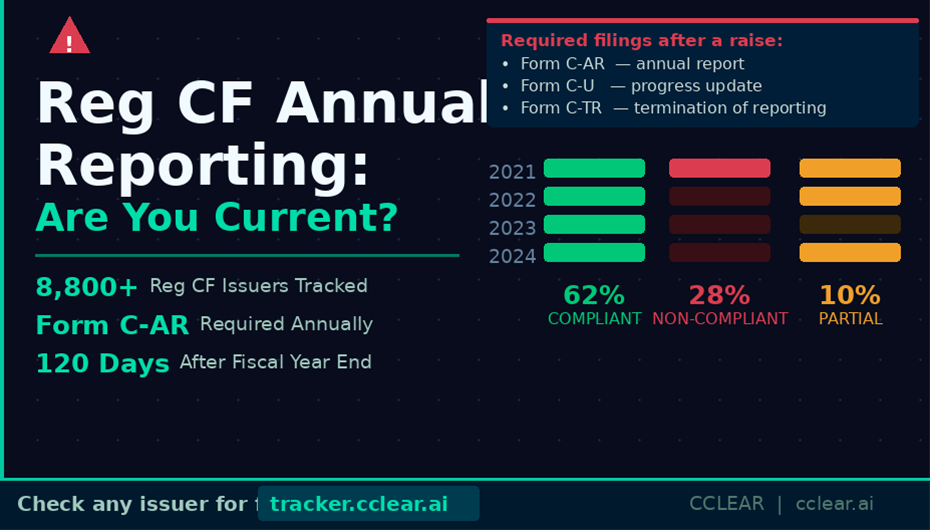
Since Reg CF went live in 2016, over 8,800 companies have raised money through equity crowdfunding - nearly 70% of them have surpassed their minimum funding target. Many — issuers, portals, CPAs, and attorneys alike — don't realize that a successful raise doesn't end the compliance clock. It starts it.
What the Law Actually Requires
Under Rule 202 of Regulation Crowdfunding (17 CFR §227.202), every issuer that completes a Reg CF offering must file an annual report on Form C-AR within 120 days of its fiscal year end — typically April 30 for calendar-year companies. This obligation continues every year until the issuer:
- Files a Form C-TR to formally terminate its reporting obligations
- Becomes an SEC reporting company
- Has fewer than 300 holders of record and has filed at least one annual report
- Has repurchased all securities sold in the offering
This isn't optional guidance. It's a binding legal requirement under the Securities Exchange Act of 1934, as incorporated by the JOBS Act.
There's also a newer obligation worth knowing about. In February 2026, the SEC Division of Corporation Finance issued new Compliance and Disclosure Interpretations (C&DI 201.03) clarifying that issuers with ongoing offerings who have completed rolling closings must file a Form C/A with updated financials, a Form C-AR, and a progress update on Form C-U — all within 120 days of fiscal year end if the offering is still open. This is a significant clarification that affects many active issuers right now.
The Risk of Non-Compliance
Non-compliance with annual reporting requirements carries real consequences:
For issuers: Failure to file can result in SEC enforcement action, loss of the exemption, and potential liability to investors. It also signals to future investors, portals, and institutional crossover funders that the company's governance is weak — a serious problem for any issuer hoping to raise again.
For portals: Under Rule 301(c)(2), intermediaries have ongoing gatekeeping responsibilities. A portal whose issuers are systematically non-compliant faces regulatory scrutiny. Staying ahead of your issuer base's compliance status isn't just good practice — it's part of your regulatory obligation.
For CPAs and attorneys: If you did the audit, review, or legal work for a Reg CF offering and your client subsequently fell out of compliance, that's a conversation you want to have proactively — not after an SEC inquiry.
How to Check Right Now — For Free
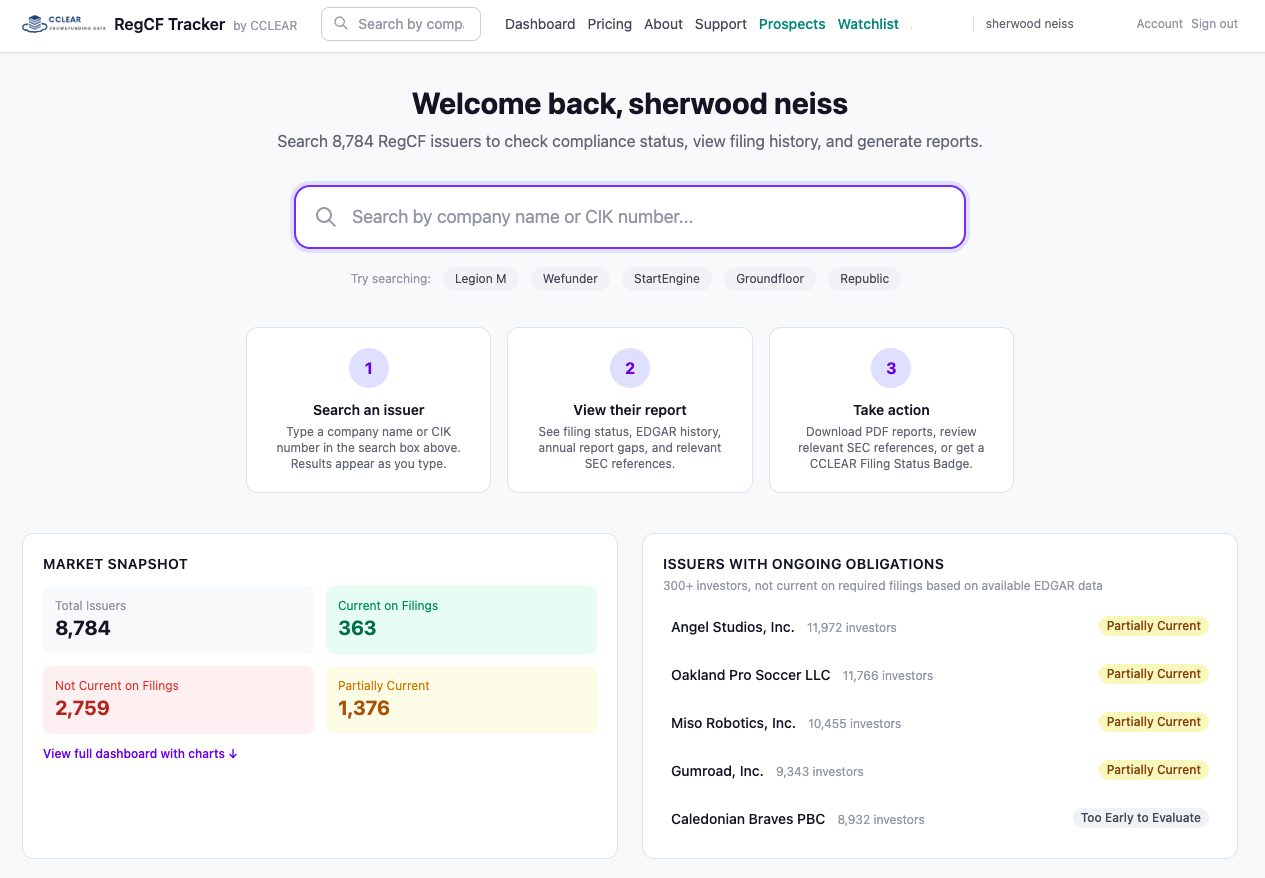
There is now a publicly accessible tool that monitors annual reporting compliance for all 8,800+ Reg CF issuers, pulling directly from SEC EDGAR in real time.
At tracker.cclear.ai, anyone can search any issuer by company name or CIK and immediately see:
- Whether required C-AR filings have been made
- How many annual reports were filed vs. how many were required
- The issuer's current compliance status: Compliant, Non-Compliant, or Partial
- A full EDGAR filing history with direct links
There is no cost to search. No account required for basic lookups.
This is useful for issuers who want to verify their own status, for portals doing diligence on their issuer base, and for investors who want to understand whether a company they backed is meeting its ongoing obligations.
A Note for CPAs and Attorneys in the Ecosystem
If you do audit, review, or legal work for Reg CF issuers — or if you're looking to build that practice — the compliance gap in this market is significant. Hundreds of issuers are currently non-compliant and actively need professional help getting current.
The tracker's search function lets you identify non-compliant issuers by state, which makes it straightforward to find companies that need a CPA or attorney in your area. At $600–$12,000+ per engagement depending on offering size, and with annual recurring needs, this is a practice area worth exploring for professionals already familiar with securities compliance.
The Bottom Line
Regulation Crowdfunding gave thousands of small businesses access to capital that didn't exist before. But the compliance obligations that come with that capital are real, and the ecosystem has a shared interest in making sure issuers understand and meet them.
If you work with Reg CF issuers in any capacity — as a portal, service provider, investor, or advisor — it takes about 30 seconds to check whether they're current.
Search your issuers at tracker.cclear.ai.
The author is one of the original founding members of the CfPA, co-author of the JOBS Act crowdfunding framework, and founder of Crowdfund Capital Advisors.
Register for FREE to comment or continue reading this article. Already registered? Login here.
2