
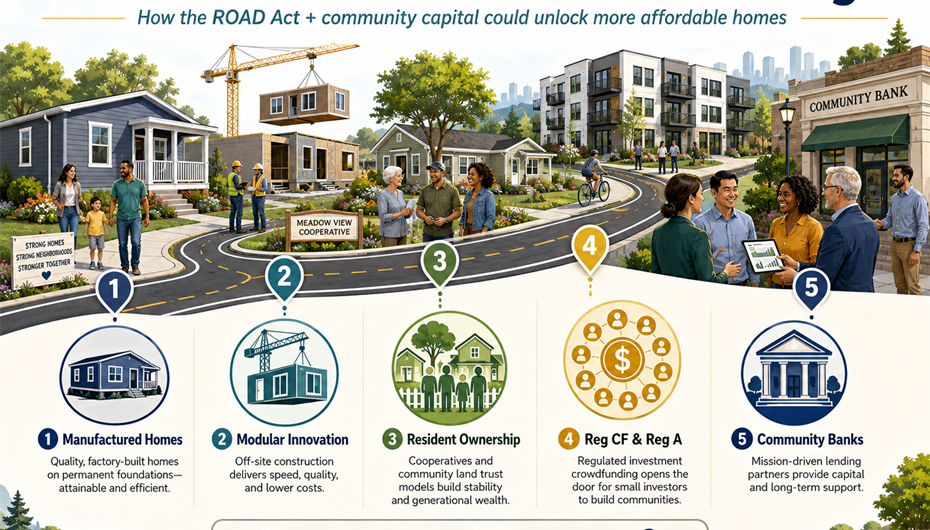
A rare bipartisan law could help communities pair factory-built homes with community capital
A New Hope
Every once in a while, Congress does something that gives me genuine hope.
The 21st Century ROAD to Housing Act became law on July 11, 2026, after passing both houses of Congress with broad bipartisan support. Remarkably, the president neither signed nor vetoed it. Because Congress remained in session, the bill became law without presidential approval after the constitutional review period expired—an unusual path for a major piece of legislation.
The law is enormous. It touches zoning, public land, rural housing, homelessness, veterans, home repairs, mortgage lending, disaster recovery, community banking, manufactured housing and modular construction.
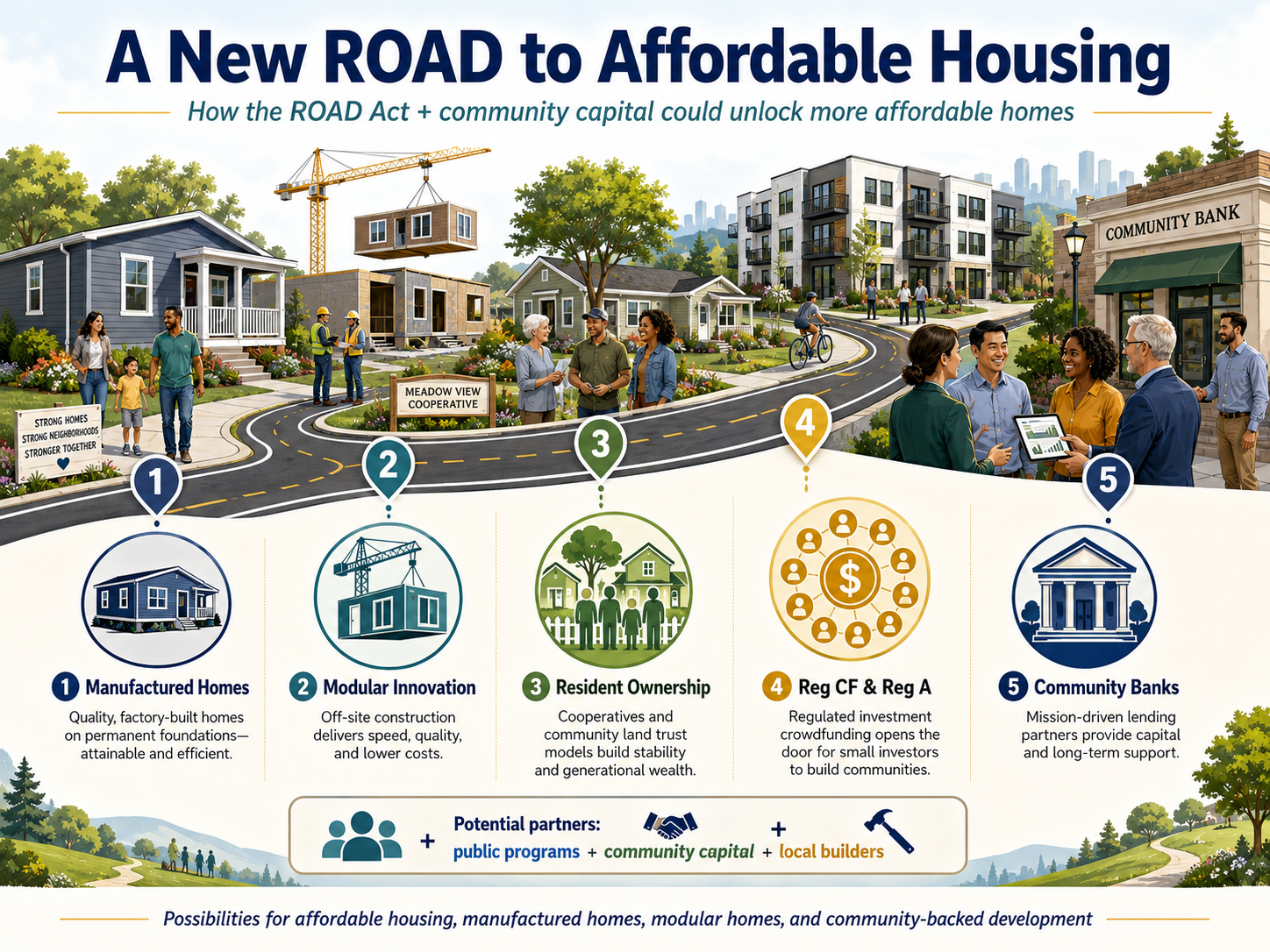
What excites me most is not any single program. It is the possibility of combining the law’s housing tools with regulated investment crowdfunding.
 |
Regulation Crowdfunding allows an eligible company to raise up to $5 million in a 12-month period through a registered funding portal or broker-dealer. Regulation A allows public offerings of up to $75 million. Both can enable ordinary people—not just wealthy investors and large institutions—to invest in projects they believe will benefit their communities.
The ROAD Act does not explicitly connect these securities exemptions to housing policy. We have to make that connection ourselves.
The manufactured-housing opportunity
The law devotes an entire title to manufactured and modular housing. That may be where it creates the greatest opportunity to produce homes that people of modest means can actually afford.
The act changes the federal definition of a manufactured home so that one may be built with or without a permanent transportation chassis. HUD must now establish standards for chassis-free manufactured homes, including special labels and documentation that distinguish them from traditional chassis-built homes.
This sounds technical, but the implications could be significant.
The permanent steel frame under a traditional manufactured home is useful during transportation, but many homes never move again after installation. Allowing a home to be built without retaining that chassis could support lower profiles, more conventional foundations, greater design flexibility and even multistory configurations.
A chassis-free manufactured home would still be regulated under the federal HUD Code. The reform does not simply eliminate safety standards. Instead, it directs HUD to develop standards appropriate for this new construction method.
In practice, the change could help manufactured homes look, function and finance more like conventional real estate—especially when a home is permanently installed on land owned by the resident.
That last point matters enormously to me.
Manufactured housing can provide affordable homeownership, but the traditional mobile-home-park model contains a troubling contradiction: the resident may own a house that is too expensive or difficult to move while someone else owns the land beneath it. A landlord can raise the lot rent, neglect the infrastructure or sell the entire community.
The ROAD Act offers two promising alternatives.
First, it substantially increases FHA Title I financing limits for manufactured homes, including purchases that combine a home with a developed lot. The law also provides for annual adjustments to those limits.
Second, the law gives statutory authorization to the PRICE program—the Preservation and Reinvestment Initiative for Community Enhancement. PRICE grants can support land acquisition, infrastructure, repairs, replacement homes, expansion and preservation within qualifying manufactured-home communities.
Crucially, the law expressly recognizes communities owned by residents through cooperatives or other resident-controlled entities. It also prioritizes long-term affordability for low- and moderate-income households.
Imagine residents using a PRICE grant, a community-bank loan and a Reg CF offering to acquire the land beneath their homes.
Neighbors, local businesses and impact investors could help provide the flexible capital needed to close the purchase. The residents could collectively own the community, control lot charges and preserve affordability over the long term.
Another model may be even simpler: a developer could use Reg CF or Reg A to acquire land, install infrastructure and place high-quality manufactured homes on permanent foundations. Each completed home could then be sold with its own lot under a unified real-estate title and mortgage.
The crowd would help finance the development without becoming the homeowner’s permanent landlord.
That could be transformative.
Modular homes could move faster, too
The ROAD Act also addresses modular housing—homes built in factory sections under the state and local building codes applicable where they will be installed.
The law directs HUD to review FHA construction-financing programs for barriers that disadvantage modular construction. One specific problem is the traditional construction draw schedule. Lenders often release funds after work is completed at the building site, while modular builders incur much of their expense inside a factory before the home ever reaches the property.
HUD must study that mismatch and begin a rulemaking process examining alternative draw schedules for modular and manufactured-home developers. The law also contemplates standardized systems for serializing and securing modules, potentially making factory-built components easier for lenders to recognize as collateral.
Azure Printed Homes, led by SuperCrowd community member Gene Eidelman, is one company that could benefit from the ROAD Act. Azure manufactures modular homes using robotic 3D printing and has already raised millions of dollars from investors, including through regulated crowdfunding.
The law also supports prereviewed building designs and pattern books. Local governments could adopt standard ADU, cottage, duplex, townhouse or small multifamily designs that would not need to undergo a complete design review with every new project.
That could pair beautifully with factory production. A repeatable home design deserves a repeatable permitting and financing process.
Small Change is ready for this moment
We do not need to invent a new crowdfunding system for real estate. It already exists.
Small Change, founded by Eve Picker, operates a registered Reg CF funding portal focused on real estate and community impact. It has already hosted offerings for affordable infill housing, ADUs, community land trusts, cooperative ownership, workforce housing and homes for people who have experienced homelessness.
One Small Change offering helped finance a San Francisco Community Land Trust project designed to preserve 40 homes as permanently affordable housing and convert the property to cooperative ownership. Another raised capital for an eight-unit Los Angeles development serving formerly homeless residents.
Small Change appears perfectly positioned to help a new generation of ROAD-enabled projects raise community capital.
New banks could become new partners
The law also tries to strengthen community banks and encourage the formation of new ones.
It raises the public-welfare investment limit for national and state member banks from 15 percent to 20 percent of capital and surplus. It also creates regulatory planning, pilot programs and studies intended to encourage new banks, including rural institutions, minority depository institutions and community development financial institutions.
This potential may take years to develop. Still, I can imagine new mission-oriented banks operating much like CDFIs, partnering with Reg CF and Reg A issuers to finance affordable housing.
A community bank could provide the senior loan. Crowd investors could provide equity or subordinate debt. Public programs could support land, infrastructure or affordability. Philanthropic capital could absorb some of the early risk.
Each participant would do what it does best.
The ROAD ahead
One caution should be obvious: none of this happens automatically. Federal rules must be written, programs must be funded, local approvals must be secured, securities laws must be followed and every project must be competently structured, built and managed.
Still, the possibilities are real.
The ROAD Act creates new tools for manufactured-home ownership, resident-owned communities, modular construction, public-land development, infrastructure, community banking and small-dollar mortgages.
Reg CF and Reg A can provide something the law does not: a way for ordinary people to help finance the housing solutions their communities need.
Perhaps the next great affordable-housing development will not be financed solely by Wall Street or Washington. It may be financed by future residents, neighbors, local banks, CDFIs and impact investors working together.
Congress has helped clear a new road.
Now, who is ready to build on it?
Register for FREE to comment or continue reading this article. Already registered? Login here.
3