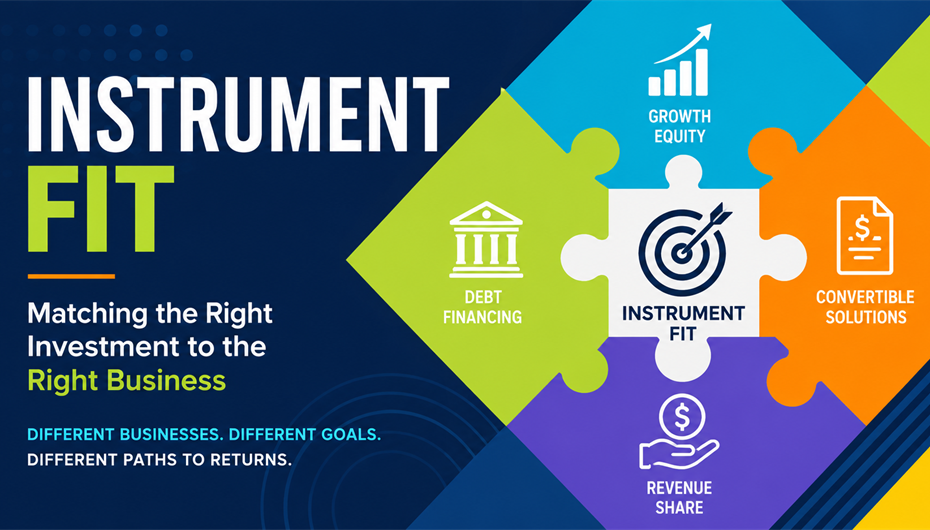
Instrument Fit: Matching the Security to the Business in Regulated Investment Crowdfunding
When Regulation Crowdfunding (Title III of the JOBS Act) launched in 2016, the industry's first challenge was simple: prove that ordinary investors could participate responsibly in private-company investing and that startups could successfully raise capital from their communities.
To do that, the market relied on familiar securities. Common stock, convertible notes, and later SAFEs had already been developed for venture-backed startups pursuing rapid growth and eventual exits.
That made sense.
Today, however, Regulated Investment Crowdfunding (the umbrella term CfPA has adopted as a Recommended Best Practice for the SEC- and FINRA-regulated exemptions created by the JOBS Act, of which Regulation Crowdfunding is one) serves a much broader market. Established operating businesses, consumer brands, technology startups, local enterprises, real estate ventures, and mission-driven organizations all raise capital under these exemptions. These businesses have very different capital needs and v...more
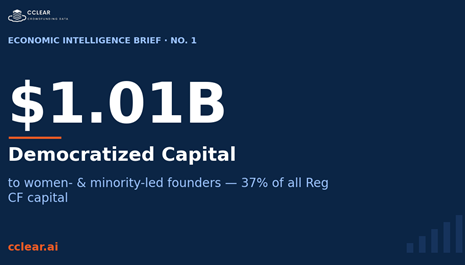
37% of all RegCF Capital has Gone to Women/Minority Founder Companies
More than $1 billion has gone to women- and minority-led companies through Regulation Crowdfunding. That's 37% of all the capital raised.
For comparison: all-women teams get about 2% of traditional venture capital.
When you let the crowd decide, the capital distributes very differently. Women- and minority-led founders' share has climbed from 24% in 2016 to nearly 39% today, across 52 states and territories.
This is what democratized access to capital actually looks like in the data.
A question for the room: is the crowd better at backing founders that institutions overlook, or is venture capital simply optimizing for something else? Curious where people land.
Comment "CCLEAR" and I'll send you the full brief.

When a company crowdfunds a second time, what happens to its valuation?
When a company crowdfunds a second time, what happens to its valuation?
We followed 713 companies that went back to the crowd for at least two priced rounds and tracked each one's valuation across its own journey.
79% came back at a higher valuation. The median company grew from a $10M cap to a $19.8M cap, a 1.54x step up, in a median of just 15 months. The top decile exceeded 5.9x.
Add it up and the roughly $970M invested in those earlier rounds now marks to $2.64B at latest-round prices. That is $1.67B of unrealized paper markup sitting with early investors.
One honest caveat: this is paper, not proceeds. These are primary-round prices, not exits, and early investors get diluted along the way. But the direction is unmistakable. The crowd is pricing these companies up.
A question for the room: when a company comes back and prices at double its first cap, is that real value creation or optimistic pricing? Curious where people land.
Comment "CCLEAR" and I'll send you the full brief.

A New ROAD to Affordable Housing
A rare bipartisan law could help communities pair factory-built homes with community capital
A New Hope
Every once in a while, Congress does something that gives me genuine hope.
The 21st Century ROAD to Housing Act became law on July 11, 2026, after passing both houses of Congress with broad bipartisan support. Remarkably, the president neither signed nor vetoed it. Because Congress remained in session, the bill became law without presidential approval after the constitutional review period expired—an unusual path for a major piece of legislation.
The law is enormous. It touches zoning, public land, rural housing, homelessness, veterans, home repairs, mortgage lending, disaster recovery, community banking, manufactured housing and modular construction.
What excites me most is not any single program. It is the possibility of combining the law’s housing tools with regulated investment crowdfunding.
Regulation Crowdfunding...more
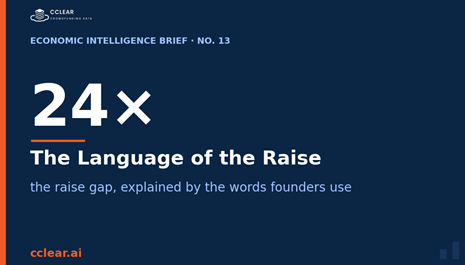
Words matter in your pitch - We know ... we analyzed 6,800 of them!
We read 6,800 funded RegCF pitches. The words that raise the most money aren't the ones you'd expect.
The gap between a top-quartile raise and a bottom-quartile one is 24x. So we ran the language through NLP to see what separates them.
It isn't hype. "Revolutionary" and "disrupt" don't move the needle. Sentiment, length, and buzzwords like "traction" show no advantage at all.
What the big raises actually talk about: FDA approvals, clinical pipelines, recurring revenue, clean energy, real assets. The language mirrors the business — substance beats spin.
Comment "CCLEAR" and I'll send you the full brief. #Startups #NLP #Fundraising #RegCF #DataScience
...more
The #1 city for startup crowdfunding in America isn't San Francisco.
We ranked America's top 30 startup-crowdfunding ecosystems. Los Angeles came out #1 — ahead of San Francisco and New York.
Each metro is scored 1–10 across five factors: momentum, capital, expertise, network, and scale. The headline isn't just the order — it's that no single city wins on everything. LA leads on capital, San Diego on scale, Cleveland (yes, Cleveland) on the experience of its founders.
And the map is wide: the top 30 span 20 states, holding 73% of all funded activity.
Where does your city rank?
Comment "CCLEAR" and I'll send you the full brief.
#Startups #EconomicDevelopment #Entrepreneurship #RegCF #Innovation
...more
How Interest Rate in Debt Offerings has Changed
The cost of crowdfunded debt doubled — and it tracked the Fed almost perfectly.
We mapped the actual terms behind every funded Reg CF deal. The median interest rate on crowdfunded debt and convertibles rose from 5.5% in 2016 to 11.5% in 2024 — moving in lockstep with the rate-hike cycle.
At the same time, Reg CF quietly became a small-business debt market: loans went from under 8% of deals to more than 1 in 5.
Crowdfunding isn't just equity anymore. It's a financing menu — and it has a price.
Comment "CCLEAR" and I'll send you the full brief.
...more
1 in 2 crowdfunded companies stop reporting - here's what we see after the raise
Only about half of the companies that crowdfund ever file an annual report. We tracked every Reg CF company with a reporting obligation since 2016. Of those whose first report has come due, just 50% have ever filed one — and most who do file only once, then go quiet.
For the half we can still see, the story is good: aggregate revenue grew 1.8x since the raise, and those companies disclose more than 28,000 direct employees — roughly 224,000 jobs supported once you count the indirect jobs each one sustains (Paychex 8x).
But the reporting gap is real — and it's a question every policymaker studying small-business capital should be asking.
Comment "CCLEAR" and I'll send you the full brief.